
Drafty, foggy or hail-cracked windows, replaced with windows rated for a Nebraska winter. Callaway Construction Inc. works across the Omaha metro from Gretna, with the owner on the job from measuring to the last piece of trim.
A window that fogs between the panes, lets in a draft you can feel, sticks, or sits on a soft, stained sill is telling you something. Callaway Construction Inc. replaces and installs windows across the Omaha metro from Gretna, including the windows in remodels, additions and re-sides.
Chris Cannon has run the company since 1995. He measures, writes a line-item bid and runs the job himself, so the person who looked at your windows is the person on site when the openings are open.
Chris will tell you at the walkthrough what he sees and what he would do about it.
Insert replacement sets a new window inside the existing frame. The trim inside and out stays, it is the quicker of the two, and the glass ends up a little smaller. It only works when the old frame is square, solid and dry.
Full-frame replacement takes the old window out down to the framed opening. That shows any rot in the sill or framing, lets the opening be flashed and sealed again to the new window maker's instructions, and gets new trim. It is the right call when water has been getting in, and the natural choice during a re-side, when the wall is open anyway.
After a storm, check the glass, the screens, and the frames and metal wrap on the side the storm came from, and take dated photos before anything is repaired. If an insurance claim will pay for the work, Nebraska law gives you three business days to cancel the contract and bars any contractor from covering your deductible. The details, and how to compare storm bids, are on our hail damage repair page.
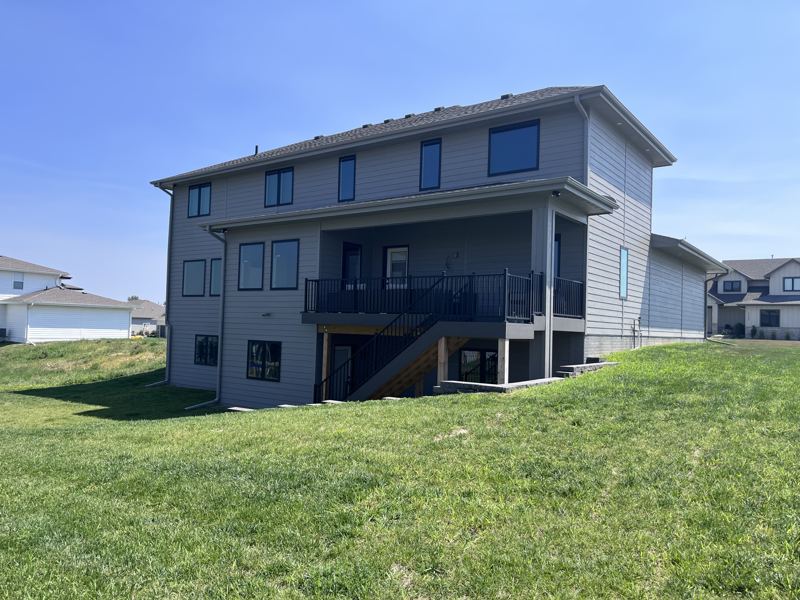
Photo at the top: a covered deck and walkout stairs our crew built.
Owner-run since 1995. Chris Cannon bids the job, runs the job and answers the phone. Same crew, same owner on site, same line-item bid.
From measuring to the last piece of trim, with one point of contact.
A rated window carries a label from the National Fenestration Rating Council with the numbers worth comparing:
ENERGY STAR puts Douglas and Sarpy counties in its Northern climate zone. For windows there, its current criteria call for a U-factor of 0.22 or lower with an SHGC of at least 0.17. Windows with a U-factor from 0.23 to 0.26 can also qualify if they let in more of the sun's heat: an SHGC of at least 0.35 at 0.23 and 0.24, and at least 0.40 at 0.25 and 0.26. Look for a label with the Northern zone marked.
Vinyl frames never need paint and stand up to moisture. Fiberglass holds its shape through big temperature swings. Wood insulates well but needs regular upkeep; aluminum or vinyl cladding on the outside cuts that down. Bare aluminum frames carry heat straight out, a poor fit for a Nebraska winter. And the frame matters less than the glass and the install: a well-rated window in a badly flashed opening still leaks.
Cutting a new window opening or making one bigger is a different job from a replacement. It changes the framing, so in Gretna it needs a permit even though a same-size replacement does not, and a basement bedroom window has its own size rules so people can get out in a fire. Bring it up at the walkthrough.
Five steps, one point of contact, and a phone that gets answered.
The quote form or a phone call. How many windows, and a photo or two, is plenty to start.
Chris measures, checks the sills, frames and the wall around them, and talks through insert or full-frame.
Each window, the install method, trim and any repairs on their own lines.
Same crew, owner on site. Old window out, opening checked, new window set, flashed, sealed and trimmed.
Every window opened, closed and locked with you.
In Omaha, yes: window replacement is its own residential permit type. La Vista covers windows on its light remodeling permit. In Gretna, windows that fit the existing opening do not need a permit, but a new or enlarged opening does. Chris can tell you at the walkthrough what he expects your job to need.
ENERGY STAR's Northern zone, which covers Douglas and Sarpy counties, asks for a U-factor of 0.22 or lower with an SHGC of at least 0.17, or a U-factor up to 0.26 paired with a higher SHGC. Lower U-factor means less heat lost in winter.
The seal on the insulated glass has failed and moist air has gotten between the panes. Cleaning will not fix it. If the frame and sash are sound, sometimes only the glass unit needs replacing; otherwise it is a new window.
Insert keeps the old frame and trim and is quicker, with slightly less glass. Full-frame takes the window out to the opening, which shows any rot and lets the opening be flashed again. If water has been getting in, or the siding is coming off anyway, full-frame is the better choice.
Moist indoor air meets cold glass and condenses. Windows with a lower U-factor keep the inside glass warmer, which helps, but indoor humidity matters as much: running bath and kitchen fans and turning a humidifier down in very cold weather make a difference.
Yes, and it is the natural time to do it. With the siding off, each opening can be flashed into the new water-resistive barrier and trimmed to match the new siding.
Start a quote on this site or call (402) 740-6572. Tell us how many windows and send a photo or two. Chris measures and you get a line-item bid. Quotes are free.
Tell us how many windows and what they are doing. Chris will get back to you within a business day.